Why the official temperature isn't your street's heat
The temperature on the evening news is air temperature, measured in the shade inside a white, ventilated screen between 1.25 and 2 metres above the ground. What you feel on the pavement also depends on direct sun and on how hot the ground is: with the air around 40 °C, a sunlit surface can climb well past 60 °C, while one under a tree stays far cooler. That is why two streets with the same official reading can feel completely different.
How is the official temperature measured?
Spain's weather agency, AEMET, follows World Meteorological Organization standards. The sensor sits inside a white, slatted shelter that keeps out sun and rain but lets air flow through. It is mounted 1.25 to 2 metres high, on open ground away from rooftops and slopes, so the reading represents a wide area.
The goal is to measure the air and nothing else. That makes the figure useful for comparing days, years and cities. It does not tell you what is happening on a specific pavement at four in the afternoon.
How hot does asphalt get in the sun?
Much hotter than the air. The US Environmental Protection Agency (EPA) reports conventional pavements reaching up to 67 °C (152 °F) at midday in an Arizona pilot study. In another Arizona study, with the air at 41.6 °C, researchers measured a playground:
- rubber surface in full sun: 87.2 °C;
- the same surface under a shade sail: 46.7 °C;
- the same surface under a tree: 42.2 °C.
Same air temperature, yet roughly 45 degrees between sun and shade on the ground.
Why does tree shade make such a difference?
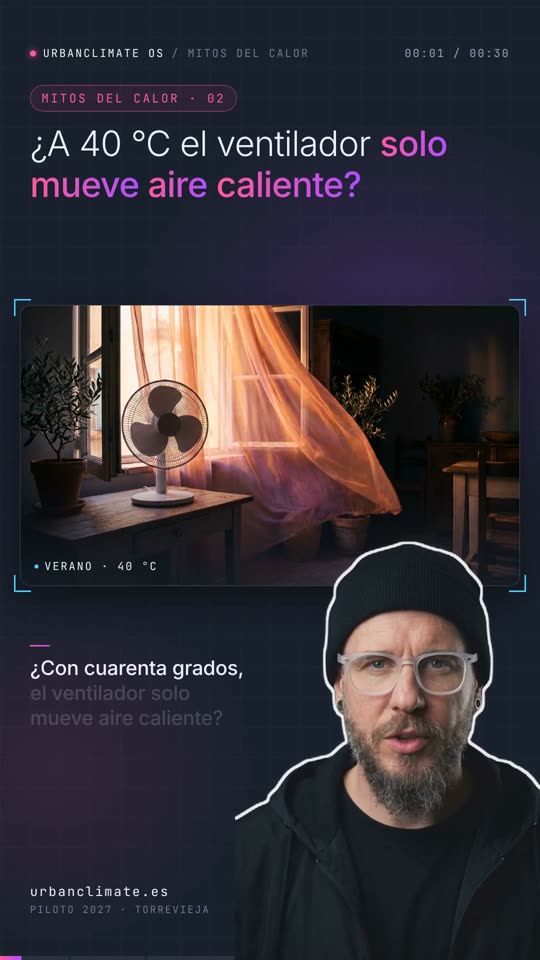
Because the heat we feel is not just about the air. As AEMET explains, feeling hot in the sun comes mostly from the radiation your body absorbs. Shade blocks that direct radiation, and a cooler surface radiates less heat back at the people walking on it.
The EPA cites a study of two buildings where tree shade lowered peak wall and roof temperatures by 11 to 25 °C. Trees also release water through their leaves, and that evapotranspiration, alone or together with shade, helps lower peak summer air temperatures.
What it means for your city
If the official figure is the same for the whole city, it cannot tell a council where to act. Shade, paving, orientation and street width all change from one block to the next. The useful questions are specific:
- Which busy pedestrian streets lack shade at midday?
- Which squares and playgrounds are large expanses of sunlit asphalt or rubber?
- Where should planting start so shade reaches pavements, bus stops and school entrances?
Answering them means measuring street by street, not relying on a single station. At UrbanClimate OS we are building a digital twin of urban heat, with a pilot in Torrevieja planned for 2027. It finds where heat is critical, explains why, and compares 22 measures, such as trees, shade and materials, by cooling effect and cost.
Which street in your town shows the biggest gap?
FAQ
At what height is official temperature measured?
Between 1.25 and 2 metres above the ground, under the World Meteorological Organization standards AEMET follows, always inside a shelter that keeps the sensor out of the sun.
Is there such a thing as 'temperature in the sun'?
Air is almost the same temperature in sun and shade; what changes is the radiation your body receives and how hot the ground is, which can exceed 60 °C.
How much does tree shade cool a surface?
In an Arizona playground with air at 41.6 °C, the sunlit ground measured 87.2 °C and the ground under a tree 42.2 °C. The EPA cites 11–25 °C reductions on shaded walls and roofs.
Want to see the heat profile of your city?
We prepare a heat profile for each municipality: extreme-heat days, tropical nights, green cover and a land-surface temperature map.
Write to usSee the platformSources
- AEMET Blog — ¿Temperaturas al sol y a la sombra? ¿Cómo se mide la temperatura en una estación meteorológica? (2022)
- Maldita.es — La temperatura del aire es la misma al sol y a la sombra (2023)
- US EPA — Using Cool Pavements to Reduce Heat Islands (consultado en 2026)
- US EPA — Reducing Urban Heat Islands: Compendium of Strategies, Trees and Vegetation (2008)
- ScienceDaily — Vanos et al., Hot playgrounds and children's health, Landscape and Urban Planning (2015)