UrbanClimate OS / Topics
Urban heat explained
Short, sourced articles on heat in cities: myths, data and solutions that work in streets and squares.

Whitewash: why it cools the house but not the streetWhite villages have a physical reason: whitewash reflects sunlight. But that light bounces onto people walking by. The answer: white walls plus shade.

Shaded walking routes: getting around in summer heatYour phone gives you the fastest route, not the coolest. How a digital twin can map shade street by street, and which routes need it most for older people.
Does a fan still help at 40 °C? What the science saysThe old rule says no fans above 35 °C. A Lancet Planetary Health study puts the limit at about 39 °C for young adults and 38 °C for healthy older adults.

Why the official temperature isn't your street's heatOfficial temperature is measured in the shade, inside a white screen. Sunlit asphalt can top 60 °C, while tree shade changes everything. Here's why.

Medellín's green corridors: how a city cooled downSince 2016 Medellín has built 30 green corridors with over 12,000 trees, cutting up to 2 °C in some areas. The figures, the cost and lessons for Spain.

Badgir windcatchers: cooling homes without electricityIn Yazd, Iran, badgir windcatchers have cooled homes without electricity for at least 700 years. How they work and what they teach cities today.
Open at night, close by day: does it still work?Opening windows at night and closing by day only half works. Ventilate by temperature, not the clock, and shade outside with shutters, not curtains.
Tropical nights in Alicante: from 19 to nearly 100 a yearA tropical night never drops below 20 °C. Alicante had 19 in 1938 and now nears 100 a year. Why cities fail to cool at night and what councils can do.
Paris OASIS schoolyards: schools against the heatSince 2018 Paris has turned asphalt schoolyards into OASIS yards with trees, permeable ground and fountains open to the neighbourhood. Data and lessons.

Do street awnings really help against the heat?From the Colosseum's velarium to Seville's streets: awnings cool the air a little but mainly block direct sun. How much they help and what towns are doing.

Puerta del Sol's shade problem: lessons from its awnings12,000 m² of stone, 32 awnings and €1.5 million. Why no trees were planted in Madrid's Puerta del Sol, and why shade should be planned before paving.
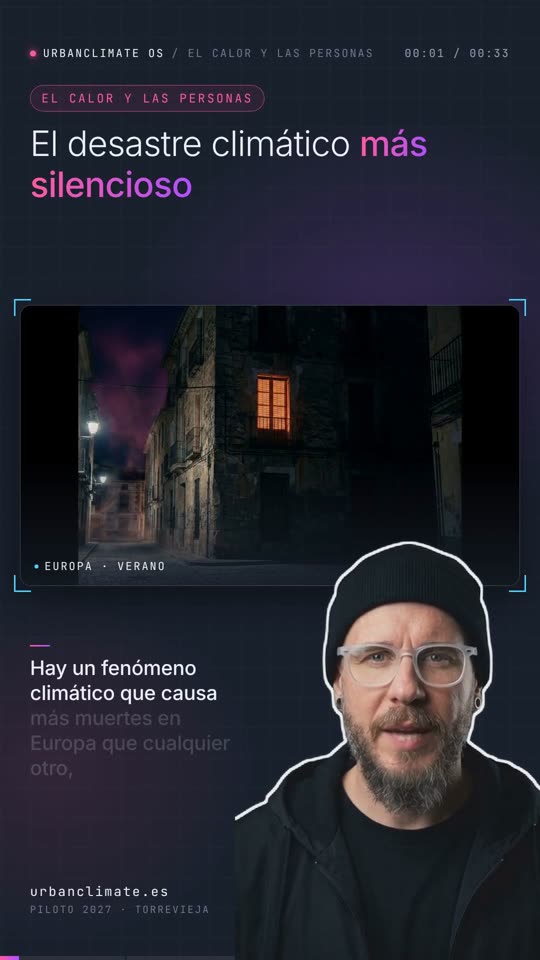
Heat-related deaths in Europe and Spain: a silent disasterSummer 2024 saw 62,775 heat-related deaths in Europe and 6,743 in Spain, according to ISGlobal. Who is most at risk, and what cities can do about it.

Did cleaner ship fuel make the ocean warmer?In 2020 ships cut the sulphur in their fuel. Fewer bright clouds over the ocean meant a little extra warming. What the studies say, and what they don't.

Is the Gulf Stream to blame for Spain's summer heat?No. The Gulf Stream mainly warms northern Europe. Heat in south-east Spain comes from a fast-warming Mediterranean and heat domes that stall overhead.
Want to see the heat profile of your city?
We prepare a heat profile for each municipality: extreme-heat days, tropical nights, green cover and a land-surface temperature map.
Write to usSee the platform